
International Cooperation in the field of Smart Grids
ERA-Net Smart Grids (European Transnational Programme Cooperation)
In order to secure a sustainable Europe it is vital to renew the electricity grids across the continent, i.e. upgrade them to the current state of the art. The aim is to create one intelligent, flexible and robust grid for the whole of Europe, capable of coping with future requirements. While doing so it is, for instance, important to increase the percentage of electricity produced from renewable energy sources and on the other hand to secure an affordable, flexible and stable supply for customers.
The renewal and adapting of the existing electricity grid is the responsibility of each individual country, while the key lies in implementing an innovative grid architecture devised by 200 experts from all over Europe, the "SmartGrids Design".
ERA-Net serves as a coordination platform which deals with the various different needs at international, national and regional level, and facilitates the flow of information between the countries taking part. Furthermore links between governmental and private organisations are to be established and a joint strategy in the field of R&D is to be created.
Austrian contacts for the ERA-Net cooperative arrangement
- Ing. Michael Hübner (Member of the Steering Committee)
Austrian Federal Ministry for Climat Action, Environment, Energy,
Mobility, Innovation and Technology (BMK)
E-Mail: michael.huebner@bmk.gv.at - DI (FH) Natalie Prüggler
FH Technikum Wien
More information: http://www.eranet-smartgrids.eu/
Smart Grids D-A-CH (Germany-Austria-Switzerland)
Electricity is the backbone of the economy and society. Increasing demand, scarcity/peaking of resources and climate change are creating new challenges for the energy system. New solutions have to be found without delay, guaranteeing a maximum of cost-effectiveness, security of supply and environmental viability. Information and communication technology (ICT) will play a key role in this process.
Austria, Germany and Switzerland have decided to cooperate as regards promoting R&D in the field of ICT-based energy systems of tomorrow. This cooperation encompasses developing and testing introduction strategies for Smart Grids. This provides further opportunities for the Austrian Smart Grids Pioneers to intensify and expand their research in the field of energy systems of tomorrow across borders. A memorandum of understanding to this effect was signed during a ceremony at the E-Energy annual conference on 26 November 2009.
In Austria the Austrian Federal Ministry for
Climat Action, Environment, Energy, Mobility, Innovation and Technology (BMK) (formerly BMVIT) is responsible for the cooperative arrangement, in partnership with the Federal Ministry of Economics and Technology (BMWi) in Germany and the Federal Agency for Energy (BFE) in Switzerland.
The cooperation focusses on the development of intelligent electricity grids, also called "Internet of Energy" or "Smart Grids". A further focal point is the integration of electro-mobility into the system.
The scope of cooperation covers the following areas of activity:
1.Information
- Exchange of know-how between actors
- Information on and coordination of funding policies
2.Synergies
- Identifying and making use of synergies
- Aiding cooperation between national projects (model regions, competence centers, etc.)
3.Cooperation
-
Collaborative solving of interdisciplinary tasks, e.g. interoperability, standardisation, safety requirements, legal compatibility, business models
4.Distribution
- Coordination of PR efforts
- Increasing acceptability to users
- Accelerating technology transfer
Each ministry has chosen an external partner for German-Austrian-Swiss coordination. For the BMK (formerly BMVIT) Fichtner IT Consulting AG is this partner.
In order to achieve useful progress fast a task force was set up for each topic of the cooperative arrangement. Each task force collects the information on results and progress within the country concerned and exchanges it with their opposite numbers from the other countries.
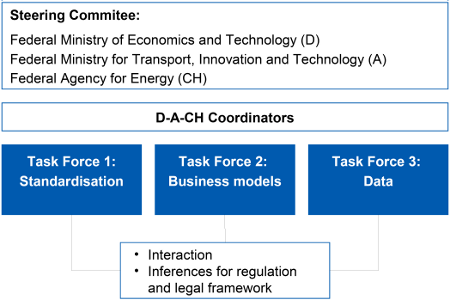
Austrian contacts for the Smart Grids German-Austrian-Swiss cooperative arrangement
- Austrian Federal Ministry for Climat Action, Environment,
Energy, Mobility, Innovation and Technology (BMK)
Ing. Michael Hübner
E-Mail: michael.huebner@bmk.gv.at - Fichtner IT Consulting AG
Dr. Albrecht Reuter
E-Mail: Albrecht.Reuter@FIT.Fichtner.de
More information: www.smartgrids-dach.eu
European SET-Plan Initiative on Electricity Grids (EEGI)
The SET-Plan, adopted by the European Union in 2008, is a first step to establish an energy technology policy for Europe. It is the principal decision-making support tool for European energy policy, with a goal of accelerating knowledge development, technology transfer and up-take, Maintaining EU industrial leadership on low-carbon energy technologies, fostering science for transforming energy technologies to achieve the 2020 Energy and Climate Change goals as well as contributing to the worldwide transition to a low carbon economy by 2050. Implementation of the SET-Plan started with the establishment of the European Industrial Initiatives (EIIs) which bring together industry, the research community, the Member States and the Commission in risk-sharing, public-private partnerships aimed at the rapid development of key energy technologies at European level. The EEGI is one of these 7 technology initiatives. Austria is contributing to it by developing the smart, active distribution grid. The Austrian Institute of Technology (AIT) is playing a leading role in the support of the initiative and was recently representing the initiative in a meeting between the European commission and the US department of energy.
The European Electricity Grid Initiative (EEGI) Roadmap 2010-18 and Detailed Implementation Plan 2010-12
European Task Force on Smart Grids
The mission of the Task Force Smart Grids to advice the Commission on policy and regulatory directions at European level and to coordinate the first steps towards the implementation of Smart Grids under the provision of the Third Energy Package. One of the three working groups of the European smart grids task force has been led by an Expert from the Austrian energy regulation body e-control.
European Task Force on Smart Grids
European Distributed Energy Resources Laboratories (DER-Lab)
Leading research institutes from eleven European states have founded the association DERlab e.V. as an independent world-class laboratory for the grid-integration of distributed power generation. DERlab develops joint requirements and quality criteria for the connection and operation of distributed energy resources (DER) and is strongly supporting the consistent development of DER technologies. DERlab offers testing and consulting services for distributed generation (DG) to support the transition towards more decentralised power systems. (www.der-lab.net)
IEA Implementing Agreement - International Smart Grid Action Network (ISGAN)
Austria is participating in the world wide smart grids development in the International Smart Grids Action Network of the international Energy Agency together with the U.S., Korea, China and many other nations. Austrian Experts have lead the topic DER integration in the former network ENARD and are now leading the transformation from EANRD to ISGAN in this area. Further more Austria is working on the development of an Annex on smart grids governance (“Smart Grids Transistion”).
IEA Implementing Agreement on Electricity Networks Analysis, Research and Development (IEA-ENARD)
IEA ENARD was an international forum dealing with energy and electricity grids on the basis of the new IEA implementing agreement. The aim was to make access to new technologies, processes and methods in the area of electricity transmission and distribution easier and subsequently create a platform which should primarily make it simple to exchange information and data. IEA-ENARD was completed on 29th of February 2012. Activities an results were integrated in the new IEA Implementing Agreement - International Smart Grid Action Network (ISGAN).